

Alabama Termite & Pest Services Birmingham, AL provides termite and pest control support for homes, businesses, rental properties, and property managers throughout the Birmingham metro area. The company operates from Bessemer and states that it serves Birmingham, Hoover, Homewood, Vestavia Hills, Mountain Brook, Bessemer, and nearby communities in Jefferson and Shelby counties.

Choosing pest control is not only about removing what is visible today. A few ants near a sink, a mouse in a garage, or termite activity near a crawlspace can point to conditions that need a more complete response. I recommend starting with an inspection, asking what the technician found, and making sure the proposed service matches the actual problem rather than a one size fits all plan.
Table Of Contents
- Key Takeaways
- Choosing Pest And Termite Help In Birmingham
- What A Termite Inspection Can Tell You
- Comparing Treatment Paths For Common Pests
- Preparing For Service And Reviewing Your Agreement
- Frequently Asked Questions
Key Takeaways
The Direct Answer For Birmingham Property Owners
Alabama Termite & Pest Services Birmingham, AL is a family owned pest and termite company that has served Alabama since 1963. Its Birmingham metro office is located in Bessemer, and the company advertises residential, commercial, termite, mosquito, rodent, and recurring pest control services.
For a homeowner, landlord, or business owner, the practical value is not simply the range of services. It is the ability to begin with an inspection and then choose between a targeted treatment, a recurring pest plan, termite protection, rodent exclusion work, or another approach based on the findings.
Decisions That Deserve Extra Attention
Before authorizing any pest or termite work, focus on these points:
• Confirm the pest and the evidence. Ask where activity was found, whether it is active, and whether the technician saw conditions that could attract pests.
• Separate pest control from termite protection. A quarterly ant or roach service is not automatically a termite agreement, and a termite agreement may not cover general household pests.
• Review agreement terms in writing. Payment schedule, renewal terms, retreatment coverage, exclusions, cancellation conditions, and any damage repair coverage should be clear before service begins.
• Ask about preparation and reentry. Treatment instructions can vary by pest, product placement, and the areas being treated.
• Know what response timing means. Alabama Termite & Pest Services states a Birmingham area response target of within 12 hours during business hours, with after hours requests addressed by 9:00 a.m. on the next business day. That target may refer to contact or scheduling rather than a completed treatment, so it is worth confirming the next available appointment.
A clear recommendation should explain both _what will be done_ and _why that method fits the property._ If either answer remains vague, pause before signing an agreement.
Choosing Pest And Termite Help In Birmingham
Who Alabama Termite & Pest Services Serves
The company states that its Birmingham metro team serves homes and commercial properties, including rentals, offices, restaurants, and properties managed by landlords or property management companies. That range matters because the workflow changes with the property type.
A homeowner may need a technician to inspect a kitchen, garage, attic access, exterior foundation, and crawlspace. A restaurant may need treatment planned around food handling, sanitation, operating hours, and staff access. A rental property often requires coordination with both an owner and tenant, especially when preparation inside the unit is needed.
The company identifies its Bessemer office as the Birmingham area location and lists regular office hours as Monday through Friday from 8:00 a.m. to 5:00 p.m. Central Time. Requests can be made by telephone at 205 425 7378 or through its online contact form.
Why Birmingham Properties Can Need Ongoing Prevention
Pest pressure often follows the conditions around a building. Moisture, leaf litter, firewood, mulch against siding, pet food, gaps around utility lines, cluttered storage, and unsealed crawlspace vents can all make a property easier for pests to use.
In Birmingham, a shaded foundation can stay damp long after rain. That does not prove termites are present, but it may create conditions that deserve inspection. Likewise, a single mouse sighting does not always mean a large indoor infestation. Still, it is a signal to inspect likely entry points around garage doors, plumbing lines, attic vents, and utility penetrations.
When Recurring Service Makes Sense
Recurring service can be useful when a property has persistent pest pressure, multiple access points, or a history of seasonal activity. It can also be a reasonable choice for properties with tenants, where a manager needs a consistent service record and a simple way to report new activity.
I would consider recurring pest service when:
• Ants, roaches, spiders, or other pests return after isolated treatments.
• The building has crawlspaces, dense vegetation, drainage concerns, or frequent exterior insect activity.
• A rental or commercial property needs scheduled documentation and regular inspections.
• The goal is prevention rather than waiting for pests to become visible indoors.
A one time service may be enough for a localized issue with a known cause. For example, a short ant trail linked to an outdoor gap may improve after targeted treatment and sealing the entry point. If activity returns in different rooms or continues after conditions are corrected, recurring service is usually the more practical conversation.
What A Termite Inspection Can Tell You
Inspection Comes Before Treatment
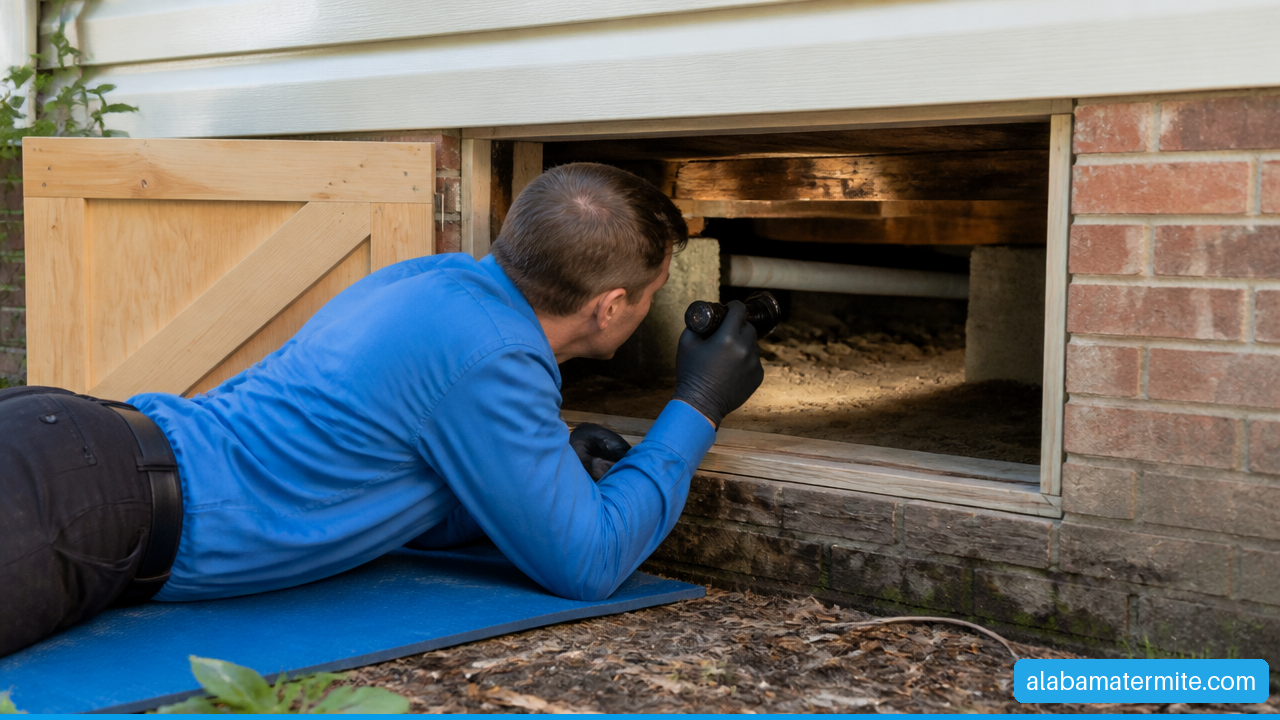
A termite inspection should look for more than insects. Technicians may look for signs of active termites, shelter tubes, damaged wood, moisture issues, wood to soil contact, foundation access points, and areas that cannot be fully inspected.
This is important because termite damage can be hidden. A wall can look normal while termites travel inside framing or behind finished surfaces. At the same time, wood damage is not always caused by termites. Moisture, fungal decay, carpenter ants, and older construction issues can create similar concerns.
Alabama Termite & Pest Services advertises free inspections. However, its available service information does not fully define whether every inspection includes a written report, a binding treatment estimate, access to all concealed areas, or documentation for a real estate transaction. Ask these questions at the time of scheduling, especially if a closing deadline is involved.
What To Ask During A Free Inspection
A free inspection can be a useful starting point, but “free” describes the inspection charge, not necessarily the scope. For example, an inspector may be able to inspect visible foundation areas but not a blocked crawlspace, an inaccessible attic, or wall cavities behind finished materials.
Ask the technician or office these questions:
- What areas of the structure will be inspected?
- Which areas could not be accessed, and why?
- Is there evidence of active termites, previous treatment, or only conducive conditions?
- Will the findings be provided in writing?
- Is the inspection suitable for a real estate or wood infestation report, if needed?
- What treatment options are available if activity is found?
- Does the proposed agreement include retreatment, inspections, repair coverage, or only a treatment warranty?
Termite Protection And Active Infestation Are Different
This distinction is easy to miss. Termite protection generally describes ongoing prevention or monitoring under an agreement. Active termite treatment is intended to address current termite activity or a confirmed infestation. The two may overlap, but they should not be treated as identical.
Consider a buyer who sees old termite repair marks in a crawlspace. The critical question is not simply whether a termite plan is available. The buyer needs to know whether termites are active now, whether the old damage is stable, what areas were inspected, and whether treatment is recommended before closing.
A preventive plan can be appropriate for a property with no visible activity but ongoing risk factors. An active infestation may require more immediate work, such as a targeted structural treatment, a baiting system, or another method selected after inspection. The exact products, active ingredients, warranties, and treatment methods offered by Alabama Termite & Pest Services are not detailed in the available service information, so those details should be confirmed in the written proposal.
Comparing Treatment Paths For Common Pests
Match The Method To The Problem
Integrated pest management means using inspection, sanitation, exclusion, monitoring, and targeted treatment together. The goal is not to spray every surface. It is to interrupt the conditions that allow pests to feed, enter, hide, or reproduce.
The table below shows how treatment decisions commonly differ by pest type. Actual recommendations should follow an inspection and the label directions for any product used.
Pest Concern | Typical Signs | Common Service Path | Key Decision Point |
|---|---|---|---|
Termites | Shelter tubes, damaged wood, swarmers, moisture concerns | Inspection, structural treatment or baiting system, ongoing protection | Is activity active, old, or only suspected? |
Ants | Trails near food, windows, plumbing, exterior walls | Targeted treatment, entry point correction, recurring service if needed | Is the colony outdoors, indoors, or both? |
Rodents | Droppings, gnawing, noises, damaged insulation | Inspection, trapping or baiting, exclusion and sanitation | Can entry points be sealed after activity drops? |
Roaches | Sightings at night, droppings, egg cases, kitchen activity | Targeted interior treatment, sanitation guidance, follow up visits | Is there a breeding population or an occasional invader? |
Mosquitoes | Biting activity near patios, standing water, dense vegetation | Source reduction and targeted mosquito treatment | Are breeding areas on the property or nearby? |
Baiting Systems, Liquid Treatments, And Other Options
For termites, the best method depends on the structure, the location of the activity, construction features, and the service agreement offered. A baiting system is designed to attract termites to monitored stations and may be paired with regular checks. A liquid treatment creates a treated zone in or around appropriate structural areas. Some properties may need a different plan because of crawlspace access, slab construction, landscaping, drainage, or prior treatment history.
There is no responsible way to declare one method best for every home. A baiting system may be attractive when ongoing monitoring is a priority. A liquid treatment may be recommended when a technician needs to establish a continuous treatment zone around accessible areas. The important step is asking the company to explain the reason for its recommendation in plain language.
For general pests, eco conscious service usually means targeted placement and prevention work rather than broad, unnecessary application. It does not mean every treatment is chemical free. If children, pets, aquariums, pollinators, gardens, or sensitive occupants are part of the household, share that information before treatment so the technician can provide property specific instructions.
Common Failure Points And Recovery Steps
Pest control can fail when the original cause remains in place. Treating ants without addressing a persistent water leak can lead to repeat activity. Setting rodent traps without sealing a gap near a utility line can turn treatment into a cycle. Applying a termite plan without resolving moisture and wood contact concerns may leave avoidable risk conditions around the structure.
If pests return, document where and when activity appears. Take a clear photo when possible, keep a brief note of the room and time of day, and contact the provider before applying multiple store bought products. Mixing products can make pest behavior harder to interpret and may interfere with a planned treatment approach.
Preparing For Service And Reviewing Your Agreement
Simple Preparation That Helps Technicians Work Safely
Preparation instructions should come directly from the service provider because they depend on treatment type. Still, a few practical steps can make an inspection or pest control visit more effective:
• Clear access to sinks, baseboards, utility rooms, crawlspace doors, garages, and known problem areas.
• Remove pet bowls, children’s toys, and food items from treatment zones when instructed.
• Tell the technician about pets, fish tanks, gardens, medical sensitivities, and areas where children play.
• Avoid moving evidence before the visit when possible. A photo of droppings, insect trails, wings, or damage can help if activity is intermittent.
• Share recent pest sightings, previous treatments, water leaks, remodeling work, and any areas that remain damp.
For termite work, access can matter even more. Stored items blocking a crawlspace opening or dense shrubs against the foundation may limit what can be inspected. If an area is inaccessible, ask that limitation be noted. It may affect both the recommendation and the certainty of the inspection result.
What To Review Before Signing
A treatment proposal should be understandable without technical guesswork. I recommend comparing the essentials in a side by side format before agreeing to a recurring plan or termite contract.
Agreement Question | Why It Matters | What To Request |
|---|---|---|
What pest or condition is covered? | General pest and termite agreements may cover different issues | A written description of covered pests and property areas |
Is this a one time treatment or recurring plan? | Ongoing visits have different costs and expectations | Visit frequency and renewal schedule |
What happens if activity returns? | Retreatment policies vary | Written callback or retreatment terms |
What is excluded? | Damage repairs, inaccessible areas, and moisture issues may be excluded | A list of exclusions and homeowner responsibilities |
How can the agreement be changed or canceled? | Terms can differ by service type | Cancellation, transfer, and renewal details |
Alabama Termite & Pest Services promotes pest callbacks and termite retreatment coverage under applicable agreements. The specific coverage, timing, and exclusions should be verified in the agreement offered for the property. Do not assume a termite plan includes structural repair coverage unless the contract says so directly.
Comparing Providers Without Guesswork
Price matters, but the lowest quote can be difficult to compare if one proposal includes follow up visits and another covers only an initial application. A better comparison looks at the full scope of protection.
Ask each provider for the same information: inspection findings, treatment method, preparation requirements, visit schedule, warranty or retreatment details, excluded conditions, and total expected cost. If one company recommends treatment but cannot explain the evidence, that is a reason to ask more questions.
Frequently Asked Questions
Does Alabama Termite & Pest Services Serve Birmingham And Nearby Suburbs?
Yes. The company states that its Birmingham metro service area includes Birmingham, Bessemer, Hoover, Homewood, Vestavia Hills, Mountain Brook, and other nearby communities in Jefferson and Shelby counties. If a property is near the edge of the metro area, confirm dispatch availability when scheduling because published service lists do not define an exact boundary line.
Is The Birmingham Area Office Located In Birmingham?
The company identifies its Birmingham metro office as being in Bessemer, Alabama. That office serves the broader Birmingham area. The listed telephone number is 205 425 7378, and regular office hours are Monday through Friday from 8:00 a.m. to 5:00 p.m. Central Time.
Is The Termite Inspection Free?
Alabama Termite & Pest Services advertises free inspections. Before booking, ask whether the visit includes a written report, which areas will be inspected, whether inaccessible areas will be noted, and whether the inspection can support a real estate transaction. A free inspection does not automatically mean every type of report or treatment estimate is included.
Does The Company Treat Active Termite Infestations?
The company advertises termite inspections and treatment options for homes and businesses. Whether treatment is needed depends on the inspection findings. Ask whether the evidence suggests active termites, old damage, or conditions that could support future termite activity, then request the recommended method and agreement terms in writing.
What Household Pests Can Be Treated?
The company offers general pest, mosquito, rodent, and termite services. Common pest control concerns may include ants, roaches, spiders, rodents, fleas, stinging insects, and occasional invaders. The right service depends on the pest, where activity occurs, and what conditions are allowing it to continue.
How Quickly Can Someone Respond To A Service Request?
The company states a goal of responding within 12 hours during business hours and addressing after hours requests by 9:00 a.m. on the next business day. Because the available information does not define whether that means a callback, appointment confirmation, inspection, or treatment completion, ask for the earliest available service date when you contact the office.
Are Children And Pets Required To Leave During Treatment?
That depends on the treatment area, pest concern, product label, and the provider’s instructions. Share information about children, pets, fish tanks, gardens, and sensitive areas before service. The technician should explain any preparation, temporary relocation, ventilation, or reentry instructions that apply to the treatment.
What Happens If Pests Return After Treatment?
Keep track of the pest, location, and date of the new activity, then contact the provider promptly. Alabama Termite & Pest Services promotes free pest callbacks and termite retreatment coverage under applicable agreements, but the exact terms can vary. Review the agreement to understand what follow up is included and what property conditions may need correction before additional treatment is effective.